

1 in 3 (33%)
Alvord Unified 7th graders (Riverside) experienced harassment or bullying in the past year.
Source: CHKS, Alvord Unified 2021–22

Starts Tuesday, January 5, 2027
Words before hands Go home safe
New year. New skills. Real-world self-defense for the middle-school years.
Middle school. The bus stop. The walk home. A group that won't back off. Youth Street Defense teaches kids ages 10–14 to see trouble coming, talk it down, and, only if they are forced to, protect themselves and get away. Stand-up and ground skills are trained together, like a youth mixed martial arts class, but in a much safer, controlled way.
The model every kid learns
Climb only as high as a situation forces you to, and always prefer the lowest rung. The goal is never to win a fight with a bully. It is to stay safe and go home.
Why this matters
Bullying is not a big-city problem or someone else's school. Here is what students themselves report, starting right here in Riverside.
1 in 3 (33%)
Alvord Unified 7th graders (Riverside) experienced harassment or bullying in the past year.
Source: CHKS, Alvord Unified 2021–22
28%
were pushed, shoved, slapped, hit or kicked at school by someone who wasn't kidding around.
Source: CHKS, Alvord Unified 2021–22
6th grade
Bullying peaks in 6th grade. That is exactly why Youth Street Defense is built for ages 10–14: the skills arrive before the hardest years, not after.
Source: NCES Digest, Table 230.40 (2021–22)
21%
were afraid of being beaten up at school.
Source: California Healthy Kids Survey, Alvord Unified 2021–22
59%
Only 59% said they feel safe or very safe at school.
Source: California Healthy Kids Survey, Alvord Unified 2021–22
1 in 4 (25%) were cyberbullied.
33% in 7th grade vs 20% in 11th grade for bullying or harassment. It hits hardest in middle school.
Same survey: CHKS, Alvord Unified 2021–22 (WestEd for the California Department of Education; Tables A2.1, A8.1, A8.3).
1 in 5 (21%)
Riverside County 7th graders were cyberbullied in the past year.
Source: California Healthy Kids Survey, Riverside County 2019–21 (Table A2.2; remote-learning years, so only the online item was reported countywide)
1 in 5 (19.2%)
U.S. students ages 12–18 reported being bullied at school (2021–22).
9%
of U.S. high school students were threatened or injured with a weapon at school in 2023 (up from 7% in 2021).
13%
of U.S. high schoolers missed school in 2023 because of safety concerns at school or on the way to school (up from 9% in 2021).
6thgrade
Bullying peaks in 6th grade.
26.9% of U.S. 6th graders reported being bullied at school, compared with 10.4% of 11th graders, and 6th, 7th and 8th grade were all 25% or higher.Source: NCES, Digest of Education Statistics, Table 230.40 (2021–22)
Survey figures are students' own answers, from the most recent public reports we could verify.
Numbers like these are not a reason to be afraid. They are a reason to be ready: the skills to see it coming, talk it down, and get home safe.
Words before hands. Go home safe.
Year-round program
The core curriculum is built for ages 10–14, the peak-bullying years, and runs year-round starting Tuesday, January 5, 2027. Training builds in stages, from foundations to pressure-tested skills, with regular belt and badge tests and parent-watch days, so you see exactly how far your child has come.
Built for the real world
This is not a sport class with self-defense added on. Every technique is chosen for one question: does it work against a bigger, aggressive person when the adrenaline hits? Here is what kids practice for, and what we teach them to do.
Stay on your feet, keep moving, line them up so you only face one at a time, and break away to the exit. We never teach going to the ground with more than one person.
Grip breaks that work for smaller hands. Break toward the thumb, the weak spot of any grip, make space, and leave. Leverage, not strength.
The most common schoolyard grabs. Kids learn to protect the neck, stay calm, frame, angle off and slip free using posture and hips.
A strong base, falling safely so a shove or trip is far less likely to end in a head injury, the sprawl to stop a tackle, and getting back up the safe way.
Escapes from being held down: bridge and roll, shrimp to make space, recover, then a technical stand-up and distance. Get up, get out.
Recognize it, create distance, put something between you, and run. We never teach kids to fight, grab or take away a weapon. Distance, barrier, run.
And the everyday stuff: teasing, threats, being singled out. Kids practice confident posture, boundary words, the verbal "fence," and how to be a helper instead of a bystander. The honest truth: no class can promise a child will never get hurt. What we promise is practical skills, drilled safely every week, and a clear plan they can use.
The framework
Every Tuesday touches all four. That is how the skills connect, so kids are not just learning moves, they are learning what to do and when.

Read danger early, set boundaries, use your voice, and walk away when you can. Most trouble is solved right here.

Cover up, break grips and grabs, defend takedowns, and create distance to escape. Staying on your feet is the goal.

Escape pins, recover position, and get back to your feet. Leverage over strength, every time. The goal on the ground is always to get up and get out.

Practice under safe, scaled stress so the skills hold up when adrenaline hits. Every scenario resets to: create distance, get to safety.
Stand-up and ground, together
A grab turns into a shove. A shove turns into a fall. That is why Youth Street Defense trains stand-up and ground skills together, the way a youth mixed martial arts program would, but built for safety first and getting away, not for winning a fight.
Defensive fundamentals
We are not teaching kids how to fight. We are teaching them how not to get hit.
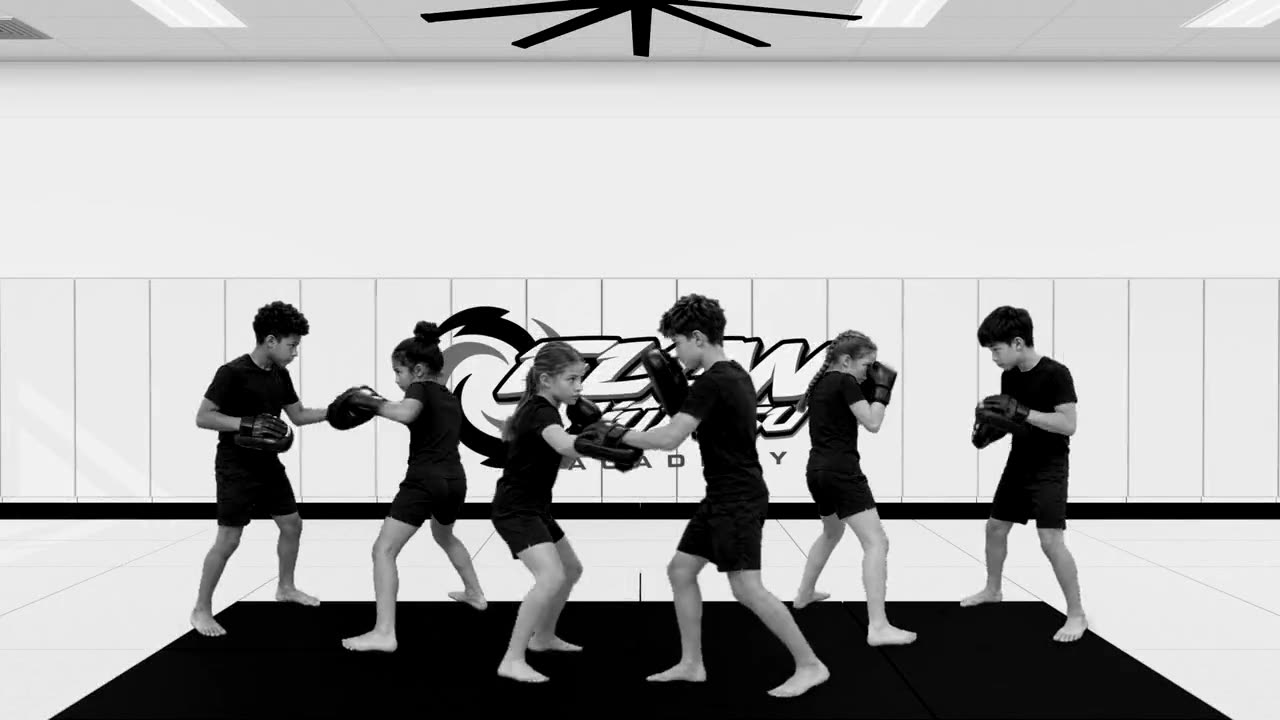
Plenty of adults who fight competitively never learned the basics properly: how to avoid a punch, how to block it, and how to time their reaction. Youth Street Defense builds those fundamentals first, with partner drills, pads and reaction games, so defending becomes automatic.
How we coach
Every technique has to work against a bigger, aggressive person when adrenaline hits. No points, no trophies.
We never teach a move that needs your child to be stronger than the person they are escaping.
We train to escape and reach safety. Never to win a fight, and never to punish anyone.
Every class opens with awareness and de-escalation. Hands are the last resort.
Age-appropriate, emotionally safe coaching. Confident, never scary. Every class ends on confidence.
Plain English, no mysticism, no gatekeeping. If something needs to be tested in person, we say so.
Year-round program
Falling and standing safely, base and posture, the verbal fence, breaking a grip, and a first ground escape.
Awareness: reading a situation, and what makes someone look like a target.
Cover and clinch, more grip and grab escapes, headlocks and wall pins, mount and side-control escapes, and getting back to the feet.
Awareness: de-escalation, pre-attack cues, and finding the exits.
Chaining skills together, scaled live scenarios, multiple-attacker awareness, then a belt and badge test and parent-watch day.
Awareness: making good decisions under stress.
Every single class
Every Tuesday follows the same shape, so kids always know what is coming and every class ends on confidence.
Movement that doubles as a skill, plus a short awareness or de-escalation lesson: reading a situation, setting a boundary, or picking an exit.
High-percentage techniques taught step by step: teach, demo, drill, then light resistance. Coaches always explain why it works.
Kids apply the skill in a short scenario with safe, scaled resistance. Every scenario ends the same way: create distance, get to safety.
Bring the heart rate down, recap the one big idea of the day, and reinforce the rule that matters most: go home safe.
Every skill is taught the same way: teach, demo, drill, then light resistance, and coaches always explain the why. Then the stages start again a level higher.
Older students add teen-level work: ambush and sucker-punch defense, stronger takedown defense, moving against multiple attackers, weapon awareness (distance, barrier, escape), and the law and ethics of self-defense, including why walking away is smart and lawful.

Who teaches it
Head Instructor · Street Defense
Youth Street Defense is Coach Carlos's own program, and he is its head instructor. He is a 4th-degree black belt and the head instructor of Flow Academy, and he built this class because it is what parents are looking for: real self-defense their kids can actually use.
His coaching runs on the same two ideas your child will hear every Tuesday. Words before hands. Go home safe.
Non-negotiable
This is the part we never compromise on.
Matched by size and age. Partners are paired by size and age, and resistance is scaled to each kid, so a younger, smaller student is never put live against an older, bigger one.
Progression
Kids can see their progress, and so can you. Skill is ranked with belts and stripes. Character is recognized with badges, because how a kid handles pressure matters as much as any technique.
Earned across the four pillars and tested at regular belt and badge tests.
Recognized when kids show it on the mat, and in how they treat each other.
Every rank test includes a de-escalation component. No rank without showing the words come before the hands, and never for attendance alone.

Parents ask
Yes. Safety is the first rule of every class. Partners are matched by size and age, resistance is scaled to each kid, and tap means stop, every time. Stand-up skills like covering up, the clinch, breaking away and takedown defense are drilled with controlled, scaled resistance and pad and shield work. Our coaches are background-checked, staff are trained in first aid and CPR, and no child is ever one-on-one with an adult unobserved.
It is built to do the opposite. Every class opens with awareness and de-escalation, and the whole program runs on one rule: words before hands. Kids learn that leaving is winning, that the goal is never to win a fight or punish anyone, and that they climb only as high as a situation forces them to. No child earns a rank without showing they can talk a situation down first.
No. Weapon training here is awareness only: recognize the danger, create distance, put a barrier between you, and get away. We never teach kids to fight, grab or disarm a weapon. Distance, barrier, run.
It is one class for ages 10–14, about 5th through 8th grade: the middle-school years, when bullying tends to peak. Our oldest students also work on skills for teens, like ambush defense and the law and ethics of self-defense. We will check that the fit is right at the free first class. Under 10? Kids Jiu-Jitsu is built for ages 6–9, and Little Ninjas for ages 3–5. 15 and up? Our adult classes are the place to start.
No. Every skill is taught step by step: teach, demo, drill, then light resistance. Nothing in the program needs a child to be bigger or stronger than anyone else. It is all leverage, timing and good decisions.
Comfortable workout clothing: a t-shirt and athletic shorts or pants without zippers or pockets. We train barefoot on the mat, so sandals and a water bottle help. The first class is free.
Jiu-jitsu and karate classes build a complete martial art over years. Youth Street Defense is built only for real situations: being grabbed, pinned, shoved or jumped by a group. It combines stand-up and ground skills, like a youth mixed martial arts class but safe and controlled. Kids learn defensive fundamentals first: how to avoid getting hit, how to block, and how to time a reaction. It adds awareness, de-escalation and scenario practice to every class. There are no points or trophies. The win is getting away and going home safe.
That is a big part of why it exists. Kids practice confident posture, a calm and firm voice, boundary words, and how to walk away with their head up. They also learn to be a helper instead of a bystander and when to bring in a trusted adult. Many situations can end with words and confidence, and the physical skills are there only if it does not.
Youth Street Defense starts Tuesday, January 5, 2027, and meets Tuesdays at 5:00 PM at our new Riverside home, 10081 Indiana Ave, Suite A-1, Riverside, CA 92503. It runs year-round, with regular belt and badge tests and parent-watch days. Pre-register now and a coach will reach out before the program starts. Your first class is free.
Your first class is free. Youth Street Defense is $125/mo with a 12-month agreement, $140/mo with a 6-month agreement, or $155/mo month-to-month. Kids already in BJJ with us can add Street Defense for $50/mo more ($235/mo for both on a 12-month agreement), and Street Defense kids can add BJJ at the same combined price. We also have a sibling discount on every program: 15% off the second child and 20% off the third.
Youth Gi Jiu-Jitsu (ages 10–14, Mondays and Wednesdays at 5:30 PM) is Brazilian Jiu-Jitsu: grappling with belts and stripes and no striking. Youth Street Defense (ages 10–14, Tuesdays 5:00–6:00 PM, starting Tuesday, January 5, 2027) is built for real situations and combines stand-up and ground skills, with awareness and de-escalation in every class. A child can do both: kids already in Flow BJJ add Street Defense for $50/mo more ($235/mo for both on a 12-month agreement).
No. Flow Academy Riverside does not run a kids boxing class, and Rise & Strike Boxing is an adult program for people with Parkinson's, not a kids class. Youth Street Defense does include pad and mitt work, plus blocking, footwork and how not to get hit, all aimed at defense and getting away rather than scoring points.
Karate and taekwondo are each a complete striking art, known for punches, kicks, blocks and forms, and plenty of kids love them. Flow Academy Riverside does not teach either one. Youth Street Defense is a different format, built only for real situations like being grabbed, pinned, shoved or surrounded, with no points or trophies. The best fit is the class your child will enjoy and keep doing.
Flow Academy Riverside does not teach Muay Thai or kickboxing. Youth Muay Thai (ages 5–9 and 10–14, with no sparring) is taught at Flow Academy Indio, 42425 Jackson St, Suite C112, Indio. In Riverside, ages 10–14 can take Youth Street Defense, which trains stand-up defense and ground escapes together but is not a Muay Thai or kickboxing class.
No. It trains stand-up and ground skills together, the way a youth MMA class does, but it is not an MMA class: there is no sparring and no competition. The goal is getting away safely, not winning a fight.
We do not teach krav maga. Youth Street Defense is Coach Carlos Miller's own program, and it shares the real-world goals many parents look for in krav maga: awareness, escaping grabs and holds, and practicing realistic scenarios. Weapons are taught as awareness only: distance, barrier, run.
Yes. Youth Street Defense is co-ed: boys and girls ages 10–14 train together, and partners are matched by size and age. Resistance is scaled to each kid, and tap means stop, every time.
Yes. Girls train right alongside boys, with partners matched by size and age, and nothing in the program needs a child to be bigger or stronger than anyone else. Kids practice the skills that matter at the bus stop and on the walk home: awareness, a calm and firm voice, grip breaks and getting to safety. Girls 10 and up can also join our women-only Women's Jiu-Jitsu class on Tuesdays from 6:00 to 7:00 PM.
No sparring. Striking is pads and mitts only, and there are no punches to the head. Stand-up skills like blocking, covering up and breaking away are drilled with controlled, scaled resistance, partners are matched by size and age, and tap means stop.
Each class is 1 hour, Tuesdays from 5:00 to 6:00 PM, starting Tuesday, January 5, 2027. Every class follows the same four parts: warm-up and awareness, a technique drill, a live scenario, and a cool-down and debrief.
Youth Street Defense teaches leverage, not strength, so no move needs your child to be stronger than the person they are getting away from. Partners in class are matched by size and age. No class can promise a result against any one person; the goal is to get away and go home safe.
Youth Street Defense is built on defense, not offense: words before hands, walk away whenever you can, and use physical skills only to get away. Our oldest students also learn the law and ethics of self-defense, including why walking away is smart and lawful. We cannot speak for any one school's discipline rules, so it is worth knowing your school's policy.
Youth Street Defense is built for in-person situations. The parts that help with online trouble too are confidence, boundary words, and knowing when and how to tell a trusted adult. It is not an online-safety course, so if your child is being harassed online, also bring in the school and a trusted adult.
Flow Academy is in Riverside at 10081 Indiana Ave, Suite A-1, Riverside, CA 92503. There is no Flow location in Corona, Norco, Eastvale, Jurupa Valley, Mira Loma or Moreno Valley, and families from all of them are welcome, along with families from Arlington, La Sierra and Woodcrest. Call or text (951) 337-3781 for directions.
Pre-register now, and a coach will reach out before the program starts. Your child's first class is free. Our new Riverside home opens in mid-November 2026, and Youth Street Defense starts Tuesday, January 5, 2027.
Starts Tuesday, January 5, 2027
New year, new skills. Put your child on the Youth Street Defense list for the start on Tuesday, January 5, 2027, and a coach will reach out before the program starts.
Youth Street Defense · ages 10–14 · Tuesdays 5:00 PM