
The Same Move, Explained Three Different Ways
August 8, 2026
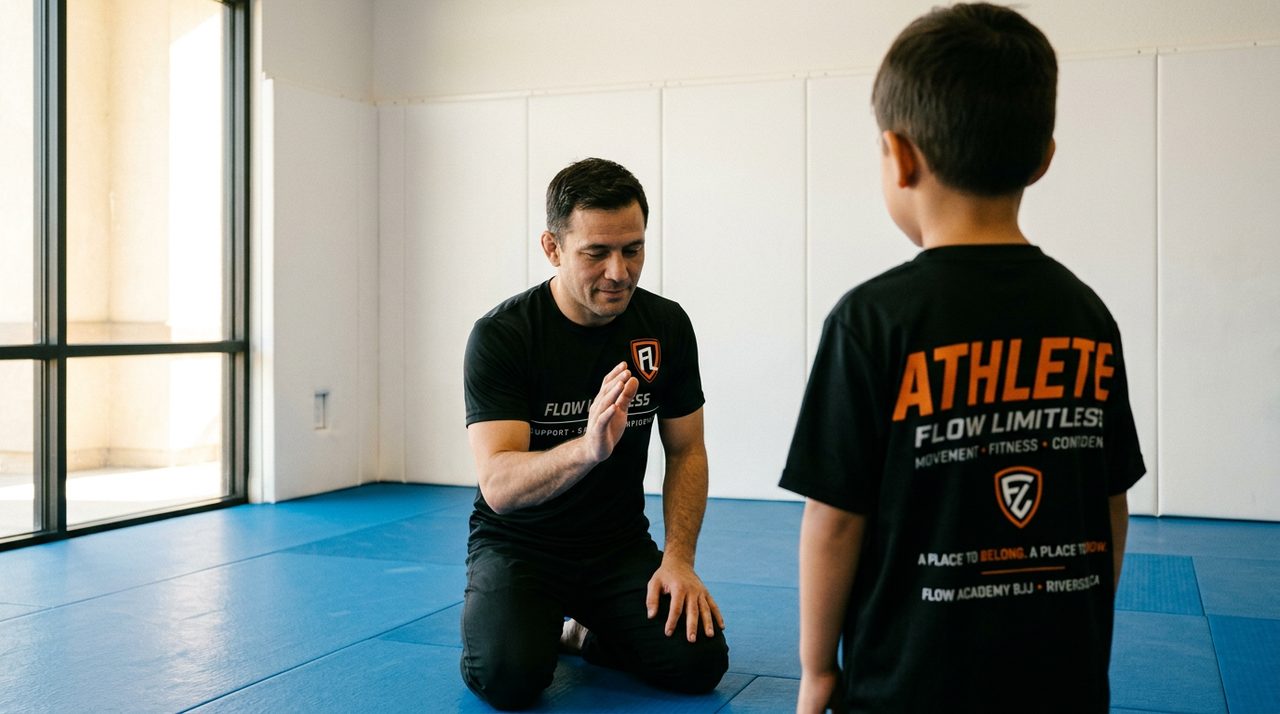
Ask a coach to teach a hip escape — the sideways shrimp every jiu-jitsu student learns in their first week — and the reflex is to start talking. Explain it, then watch the student try it. In Flow Limitless, the talking is often the first thing that has to go.
There’s a moment in a lot of our classes where a coach gives an instruction and the student in front of them doesn’t move. It isn’t stubbornness, and it isn’t a kid who wasn’t listening. The instruction just didn’t land in the form it was given. When that happens, the thing we change is us.
Said, shown, or felt
Almost anything we teach can be delivered three ways, and our coaches carry all three onto the mat every class. Some students need it said — but said shorter, in plain words, without the extra sentence a coach would normally tack on for an adult. Some need it shown, twice, slowly, from the side where they can actually see the foot doing the work, with nobody narrating over the demonstration. And some students don’t have it until they’ve felt it: a coach’s hand guiding a knee to the spot it belongs, so the body learns the shape before the brain has to turn a word into a movement.
That third one we ask about first. Every time, out loud, to the student — not only to the parent on the bench. A young person who has spent years being moved around by well-meaning adults should get to be the one who says yes. Sometimes the answer is no, and then we’re back to showing it, and that is a completely fine place to be. Nothing about the class slows down because a student didn’t want to be touched that day. If your child learns differently, book a free class and watch how it is taught.
One thing at a time
The other habit our coaches have had to unlearn is stacking. “Post your hand, turn your hips, look up” sounds like a single instruction. It’s three, and for a student working hard to hold onto the first one, the second and third arrive as noise. So we give one. The student does the one. Then the next. It feels slower for about two weeks, and then it doesn’t, because nothing has to be un-taught later.
None of this makes the movement easier. The move is the move — same technique, same standard for doing it well, same expectation that a student keeps working at it until it’s theirs. What changes is the route in. We’d rather spend four classes finding the way a student actually takes information than spend four classes repeating the same sentence louder.
We won’t tell you which of the three belongs to your child. We don’t know yet, and we’re not the right people to guess. Parents read it faster than we do, and families already working with a teacher, a therapist, or a doctor tend to walk in knowing things about how their kid takes in information that would have taken our coaches a full season to notice. Tell us on the way in and we’ll start there.
Mid-August is when we hear from the most families about this, and it makes sense — a new school year is about to hand every kid a new set of adults with new ways of explaining things. A class where the explaining bends toward the student is a steadier thing to have on a Tuesday. Flow Limitless is enrolling now, and because it runs in small groups at each student’s own pace, class times get arranged by phone rather than posted on a fixed schedule. Call or text us at (951) 337-3781 and we’ll talk through what your child needs before they ever step on the mat. The first class is always free, and since our Riverside academy is in the middle of a move, we’ll send over current directions when you reach out.
A place to belong, a place to grow — which usually starts with finding the one way a student was always going to understand it.
Come and watch a class